


Wind power new energy and industrial robots are the two most representative core application scenarios for high-end slip rings. The two types of equipment have completely different operating conditions, environmental parameters, service life standards and motion logic, putting forward essential differentiated requirements for slip rings in terms of power load capacity, environmental adaptability, wear resistance life and transmission accuracy.
General-purpose slip rings on the market cannot adapt to these two extreme scenarios simultaneously. Blind selection will easily cause failures such as corrosion failure, signal jitter, wear stuttering and rapid service life attenuation. From five core dimensions including power grade, environmental adaptation, service life standard, operating characteristics and core pain points, this article deeply compares the design differences and application challenges of wind turbine slip rings and industrial robot slip rings, and elaborates on professional customized solutions to provide reliable reference for industry selection.
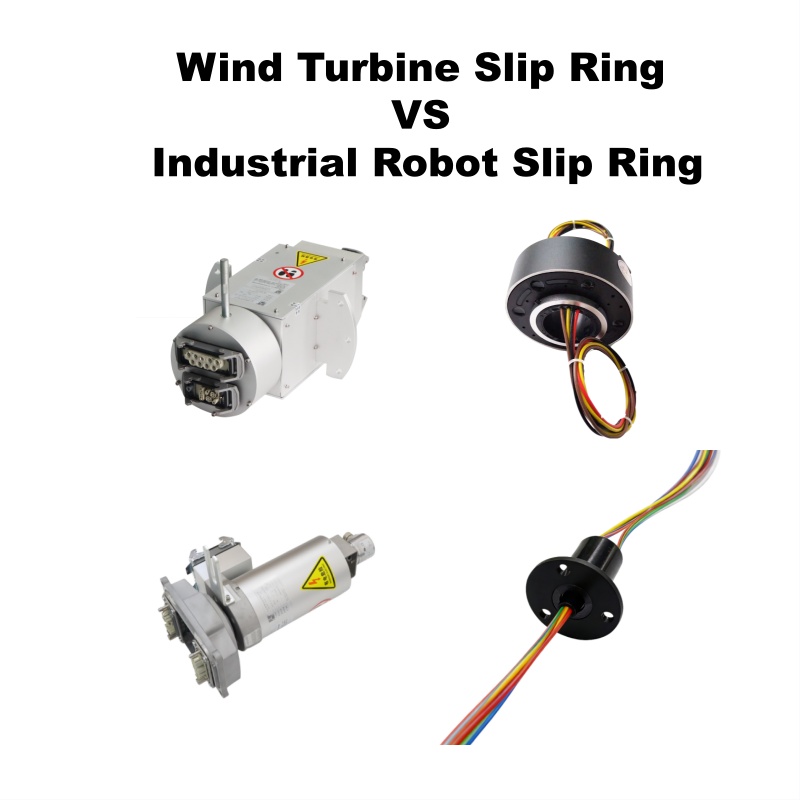
1. Overview of Core Design Differences Between Two Scenario Slip Rings
Wind power equipment focuses on ultra-long service life, extreme outdoor condition resistance and high-power continuous transmission; while industrial robots focus on clean environment adaptation, high-frequency reciprocating fatigue resistance and high-precision signal transmission. The core parameter differences are as follows:
| Comparison Dimension | Wind Turbine Slip Ring (Onshore & Offshore Wind Farms) | Industrial Robot Slip Ring (Automation Production Line) |
| Power Grade | High power and high load, suitable for megawatt-level wind power equipment, supporting continuous transmission of large current and high voltage | Mainly medium and low power, focusing on accurate signal transmission with auxiliary low-power power supply; signal precision takes top priority |
| Environmental Adaptability | Harsh outdoor working conditions, resistant to offshore salt spray corrosion, alternating high and low temperature, sandstorm, rain and high humidity environment | Indoor clean working conditions, adapted to dust-free/sterile workshops, requiring dust-free, oil-free, low-noise and zero-pollution operation |
| Service Life Requirement | Adapted to 20-year complete machine service life, with a rotational life of tens of millions of revolutions and ultra-long maintenance-free cycle | Suitable for high-frequency reciprocating rotation, with a rotational life of millions of revolutions, core requirements of anti-fatigue, anti-stuttering and anti-wear performance |
| Operating Characteristics | Low-speed continuous rotation, stable working conditions, 24-hour uninterrupted operation, rare start-stop and commutation | High-speed multi-angle reciprocating rotation, frequent start-stop and commutation, large instantaneous load fluctuation |
| Core Pain Points | Salt spray corrosion, insulation aging, long-term operation wear, extremely high outdoor operation and maintenance cost | Signal jitter, operating stuttering, oil and dust pollution, contact fatigue failure caused by frequent commutation |
2. Wind Turbine Slip Ring: Heavy-Duty Design with Extreme Weather Resistance and Ultra-Long Maintenance-Free Service Life
Wind turbine slip rings are mainly installed at the rotating parts of nacelle and hub of onshore and offshore wind turbines, undertaking the core functions of high-power power supply, control signal and sensor data transmission for pitch systems. Wind turbine equipment features difficult post-deployment operation and maintenance, especially offshore wind turbines with extremely high shutdown maintenance costs. Therefore, the core design concepts of wind turbine slip rings are extreme condition resistance, ultra-long service life, low maintenance and high insulation stability.
To adapt to harsh offshore environments including high salt spray, high humidity, drastic alternating temperature changes and sandstorm erosion, professional wind power slip rings adopt an integrated fully sealed anti-corrosion structure. The shell is made of high-strength anti-corrosion alloy with multiple passivation and anti-corrosion spraying processes. The internal multi-layer sealing structure completely isolates water vapor, salt spray and dust invasion, fundamentally eliminating metal corrosion, insulation aging, electric leakage and short-circuit faults to ensure stable operation in all climates.
To meet the requirements of tens of millions of revolutions ultra-long service life and 20-year complete machine adaptation, the product adopts high-strength wear-resistant contact pairs matched with a long-acting self-lubricating structure, which greatly reduces friction loss during long-term uninterrupted operation and effectively inhibits hidden dangers such as contact resistance drift and wear aging. Meanwhile, the optimized high-current transmission loop solves the problems of heat generation, voltage drop and discharge during high-power transmission, perfectly adapting to megawatt-level wind turbine loads, greatly reducing wind turbine shutdown maintenance frequency and effectively controlling the comprehensive operation and maintenance cost of wind power projects.
3. Industrial Robot Slip Ring: Lightweight Design with Clean Precision and High-Frequency Fatigue Resistance
Industrial robot slip rings are widely used in 6-axis industrial robots, collaborative robots, sorting robots and other equipment, serving high-end clean production lines such as 3C electronics, precision manufacturing and food & pharmaceutical industries. Robots feature high-speed reciprocating movement, frequent start-stop and flexible multi-angle commutation. In addition, clean workshops have strict requirements for pollution-free, low-noise and high-precision equipment operation. Hence, the core design concepts of robot slip rings are clean and pollution-free, precise and stable, high-frequency fatigue resistance and zero signal jitter.
In terms of environmental adaptation, robot-dedicated slip rings abandon the traditional grease lubrication structure and adopt an oil-free and dust-free dry wear-resistant process, with no debris falling off or oil overflow during operation, fully meeting the clean standards of dust-free and sterile workshops and avoiding secondary pollution to precision workpieces and production environments. Meanwhile, the lightweight and compact structure adapts to the narrow built-in installation space of robots, and the low-damping operation characteristics effectively reduce equipment operation energy consumption and abnormal noise.
In terms of performance adaptation, aiming at the working conditions of millions of revolutions high-frequency reciprocating movement and frequent start-stop commutation, the optimized elastic contact structure greatly improves the anti-fatigue and anti-impact capacity of contact pairs, which can withstand high-frequency instantaneous load fluctuations and completely solve common problems such as rotating stuttering, signal interruption and data jitter. Matched with the refined full-domain shielding design, it effectively isolates electromagnetic interference in the workshop, ensures high-precision and stable transmission of robot servo control, visual transmission and IO signals, and meets the requirements of precision automated operation.
4. Conclusion: Scenario Customization is the Core of Stable Slip Ring Operation
Wind turbine slip rings pursue corrosion resistance, long service life, heavy load resistance and maintenance-free performance to adapt to extreme outdoor heavy-duty working conditions; industrial robot slip rings pursue cleanliness, precision, fatigue resistance and high stability to adapt to high-end indoor precision automation scenarios. Although the two products have similar appearances, they are completely different in material selection, structural design, process treatment and performance debugging, with no universal alternative solution.
Focusing on the R&D, customization and precision manufacturing of slip rings, we refuse generalized universal design. We provide one-on-one exclusive slip ring solutions targeting the working condition pain points of subdivided industries such as wind power, industrial robots and packaging automation, accurately matching the power, service life, environment and precision requirements of different scenarios, and safeguarding the stable operation of high-end automation equipment.
In packaging automation production lines for food, daily chemicals, pharmaceuticals and other industries, the EtherCAT bus has become the core communication solution for high-speed packaging equipment to realize multi-axis servo linkage, visual positioning and high-speed cutting by virtue of its high real-time performance and high synchronization. However, most production lines commonly suffer from intractable faults, including irregular equipment stuttering, bus errors, data packet loss and emergency shutdown.
Such faults are highly deceptive. The equipment can recover temporarily after restart, and cannot be located through conventional electrical troubleshooting, circuit inspection and program debugging, troubling production operation and maintenance for a long time. A large number of on-site cases prove that most intermittent EtherCAT disconnection and shutdown faults of packaging machines are not caused by system or circuit problems, but by unstable slip ring signal transmission under high-speed rotating working conditions. This article presents a complete analysis of how customized slip rings completely eliminate packaging line communication faults following the “Problem-Solution-Result” logic through a real project case.
1. Project Background and On-Site Fault Phenomena
Multiple high-speed pillow packaging production lines of a large domestic daily chemical enterprise were originally equipped with general-purpose slip rings of an imported brand. After one year of stable operation, the equipment began to suffer from frequent intermittent faults, with typical symptoms as follows:
1. During high-speed continuous operation of the equipment, frequent system alarms including EtherCAT bus error, data frame loss and slave station offline occur;
2. The faults occur randomly without fixed rules, and will trigger emergency shutdown of the whole machine in severe cases, interrupting the production rhythm;
3. The equipment recovers temporarily after restart, and operation and maintenance personnel fail to find abnormalities after checking network cables, interfaces, servo parameters and program codes.
Long-term repeated faults directly lead to reduced production line operating rate, increased defective products such as misaligned packaging and incorrect cutting, continuous growth of raw material loss, labor maintenance cost and shutdown loss, which seriously affect the large-scale and stable production of the enterprise.
2. In-Depth Root Cause Analysis
Through hierarchical isolation testing, dynamic signal monitoring and working condition simulation verification, our technical team finally confirmed the core fault cause: general-purpose ordinary slip rings with common structure and materials cannot adapt to the high-frequency real-time communication working conditions of EtherCAT.
When the packaging machine runs at a high speed for a long time, the single-point contact of ordinary slip rings will generate slight vibration and radial runout, resulting in dynamic fluctuation of contact resistance. As the EtherCAT bus requires extremely high signal continuity and stability, tiny resistance mutations will cause instantaneous signal disconnection and data frame loss, ultimately leading to bus errors and equipment shutdown. In short, traditional slip rings only meet basic power supply requirements and are completely unsuitable for high-precision transmission scenarios of industrial high-speed buses.
3. Targeted Customized Slip Ring Solution
Combined with the working characteristics of packaging equipment including 24-hour continuous operation, high-speed rotation, EtherCAT real-time transmission and complex electromagnetic environment, we launched a special precision slip ring solution for EtherCAT buses of packaging machines to solve core pain points from three dimensions: structure, material and anti-interference performance:
(1) Multi-point parallel elastic contact structure eliminates instantaneous disconnection
Abandoning the traditional single-point contact design, the multi-point parallel elastic contact structure effectively offsets the vibration and radial deviation generated by high-speed operation, maintains stable contact throughout the operation, completely eliminates hidden dangers of instantaneous poor contact and signal interruption under high-speed working conditions, and ensures transmission continuity from the physical level.
(2) Gold-plated wear-resistant contact material stabilizes high-frequency signal transmission
Adopting high-purity gold-plated wear-resistant contact material, it has the core advantages of ultra-low contact resistance, minimal resistance fluctuation, wear resistance and fatigue resistance, perfectly adapts to the high-frequency differential signal transmission characteristics of EtherCAT, and eliminates bus dropout, synchronization failure and offline faults caused by resistance mutation.
(3) Customized shielding and anti-interference design adapts to complex production line environment
Aiming at the dense layout of servo motors and frequency converters in packaging production lines, we optimize the internal wiring structure and build in a dedicated signal shielding layer to effectively isolate EMC electromagnetic interference, ensure the integrity and real-time performance of EtherCAT data transmission, and avoid communication abnormalities caused by external environmental factors.
4. Field Operation Effect and Customer Value
After the customized slip rings were installed and replaced, all EtherCAT bus faults of the equipment were completely eliminated after 12 months of full-load continuous operation verification. There was no data packet loss, bus error or sudden shutdown, and the communication success rate remained 100% stably.
In terms of production efficiency, the effective operating rate of the production line increased by more than 12%, and the packaging defective rate dropped to within 0.1%. It completely eliminated capacity loss and material waste caused by unplanned shutdowns. Meanwhile, the long-term maintenance-free cycle of customized slip rings is greatly extended, which significantly reduces equipment inspection frequency and operation and maintenance costs, and truly realizes the dual goals of stable equipment operation and production cost reduction and efficiency improvement for enterprises.
5. Conclusion
Most EtherCAT communication faults of packaging machines are not caused by electrical system or program code problems, but recessive faults resulting from the mismatch between general-purpose slip rings and high-precision bus working conditions. Instead of blindly troubleshooting electrical problems, selecting professional bus-dedicated slip rings with optimized structure and low resistance fluctuation is the optimal solution to completely eliminate such faults quickly. Focusing on customized slip ring solutions for automation equipment, we provide exclusive solutions for high-speed packaging production lines and precision bus transmission scenarios to help enterprises realize efficient, stable and low-fault equipment operation.

Post time: Jul-07-2026