


1. Why Medical Equipment Needs a Slip Ring
Wherever a medical machine rotates, it faces the same conflict: the rotating side has to turn continuously through 360 degrees, while the stationary side has to keep feeding it power, data and fluid. A hard-wired cable will wrap, twist and finally break after a few turns, or force the machine into a limited angle of travel.
A slip ring turns power, signals and even air or liquid lines into a path that can rotate without limit, so the machine no longer has to be designed around a fixed number of turns.
2. Key Applications and the Signals They Carry
01 Angiography (DSA) and C-Arms
A C-arm swings through large angles and rotates continuously during acquisition. The slip ring carries high-voltage supply to the tube, the control bus and real-time imaging data, and it simultaneously routes coolant to the tube housing so that no hose is pulled or kinked as the arm moves.
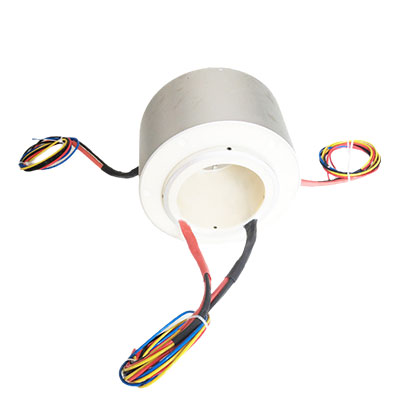
DHK100 Through-bore Slip Ring Specs: Φ100 mm bore / Φ190 mm OD / 1–120 circuits with mixed power and signal, 0–600 rpm, IP54, dynamic resistance change <10 mΩ https://www.ingiant-slipring.com/dhk100-through-bore-slip-ring-product/
02 Surgical Robots and Tele-Surgery Systems
Every rotating joint of a multi-axis robotic arm needs a reliable electrical path: servo drive power, encoder position feedback, force and torque sensor signals, and endoscopic video. Miniature slip rings can be built with a large through-bore, letting the shaft of a laparoscopic instrument pass straight through the center.
DHK038 Through-bore Slip Ring Specs: Φ38.1 mm bore / Φ99 mm OD / 1–42 circuits (2–20 A each), 0–600 rpm, IP54 https://www.ingiant-slipring.com/dhk038-through-bore-slip-ring-product/
03 Endoscopes and Optical Coherence Tomography (OCT)
Electronic endoscopes that pan through a full 360 degrees, and rotating OCT scan heads, use ultra-miniature slip rings a few millimeters in diameter, or fiber-optic rotary joints, to carry illumination power, image signals and the laser light path.
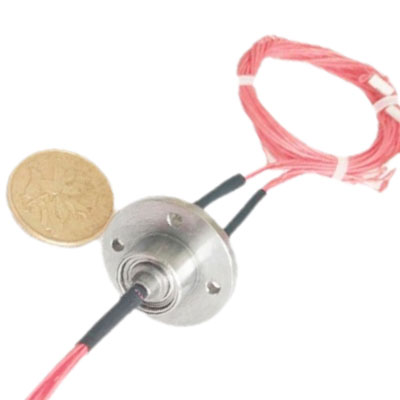
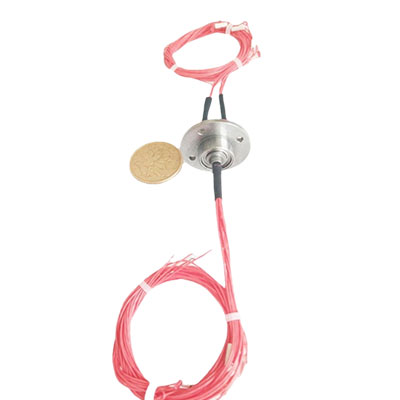
DHS012 Micro Flange Slip Ring Specs: Φ12 mm / 6 circuits at 1 A, 0–100 rpm, stainless housing; pair with HS-NF-001 FORJ
04 Laboratory and IVD Automation
Centrifuge rotors used for blood separation and nucleic acid testing can spin at high speeds, while slip rings carry power, speed and temperature signals. Sample-handling carousels transmit multiple I/O channels and barcode data.
DHS030 Micro Flange Slip Ring Specs: Φ30 mm / 42 circuits including 1 Gigabit Ethernet, 0–300 rpm, IP51 https://www.ingiant-slipring.com/flange-slip-ring-dhs030-product/
05 Operating Room and Ward Equipment
Rotating surgical lights, ceiling pendants and monitor arms carrying 4K displays must transmit lighting and drive power, HD-SDI or 4K video, USB, and Ethernet signals while they turn.
DHS020-12-2A Capsule Slip Ring Specs: Φ20 mm / 3 circuits at 8 A, 0–200 rpm, contact resistance fluctuation ≤0.03 Ω https://www.ingiant-slipring.com/ingiant-dhs020-12-2a-surgical-light-capsule-slip-ring-product/
3. Problems a Slip Ring Solves
4. What Medical Applications Demand
Medical equipment asks considerably more of a slip ring than general industrial use does. Beyond speed, circuit count and service life, four points matter most. First, quality systems and compliance. Second, electrical safety and EMC. Third, low contact noise and low outgassing. Fourth, cleanability: housing materials must tolerate repeated disinfection.
5. Parameters to Confirm Before Selecting
Through-bore (Φ3–500 mm) / Flange / Micro / Fiber Optic / Hybrid
6. Product Models Quick Links
Direct access to technical specifications and product documentation for each medical application.
Post time: Nov-16-2026