


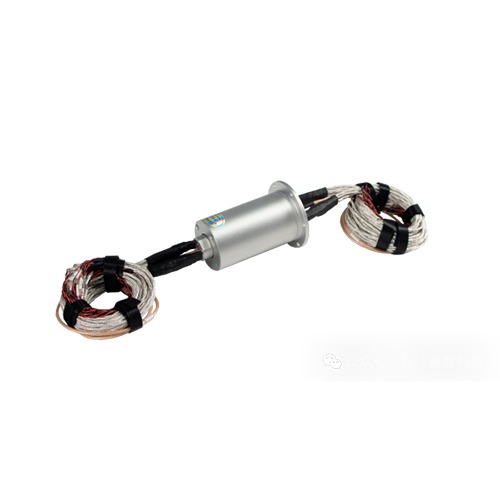
Custom slip rings maintain reliable connectivity across robots, inspection systems, packaging machinery, and wind turbines, reducing signal failures and downtime.
Modern factories are built around Industrial Internet of Things (IIoT), edge computing, real‑time sensor monitoring, and field‑bus communication. Rotary equipment — rotary tables, robotic joints, inspection turntables, packaging machinery, wind‑energy nacelles, and automotive assembly tooling — must move continuously while passing power, sensor feedback, encoder data, and industrial Ethernet traffic between stationary cabinets and rotating moving parts. Many engineering teams underestimate how much a rotary interface can break your whole industrial network stack.
Field engineers run into repeated, costly pain points when designing rotating IIoT systems. Traditional hard‑wired cables twist, fatigue, crack, and fail after thousands of rotation cycles. Cable restraints limit rotation angle and machine throughput. Wireless alternatives for rotating nodes bring latency, packet loss, RF interference from nearby motor drives, and extra hardware licensing costs. Generic off‑the‑shelf slip rings, bought purely by channel count and price, often work fine for DC power but corrupt high‑speed Ethernet, CAN bus or encoder signals. Many standard‑model slip ring suppliers only offer fixed catalog configurations. When your machine needs mixed media: power + Profinet + thermocouple + pneumatic passages in one compact unit, standard parts cannot match your mechanical envelope, electrical isolation requirements or environmental rating. The result is re‑work, prototype delays, unplanned production downtime and higher total‑of‑ownership cost for your OEM machine or end‑user factory site.
This newsletter breaks down how Ingiant custom industrial slip rings solve those exact real‑world engineering pain points. We will compare where Ingiant differs from mainstream slip‑ring vendors, walk through feature‑application‑value‑parameter for typical IIoT‑focused rotating use‑cases, and lay out our end‑to‑end custom workflow for automation system designers.
Most slip‑ring manufacturers operate on a catalog‑first business model. They mass‑produce standard series, push pre‑defined channel combinations, and expect system integrators to re‑design their machine around existing slip‑ring dimensions. Technical support is limited to datasheet downloads; custom requests get long lead‑times or flat‑out refusal. Their contact material and internal wiring layout are optimized for low‑cost power transmission, not controlled‑impedance high‑speed industrial data. When you run Profinet, EtherCAT or Ethernet/IP over these generic units, you face random packet drop, link flapping and intermittent encoder glitches that waste dozens of engineering debug hours on‑site.
Ingiant’s core business model is application‑driven custom rotary connectivity. Founded in 2014, Jiujiang Ingiant Technology Co., Ltd. is a national high‑tech enterprise located in Jiujiang National Economic‑Technological Development Zone, China. Our 30,000‑square‑meter production facility hosts more than 150 professional R&D, machining and test staff, complete CNC workshops, environmental test chambers and full electrical performance verification benches. We hold 27 patents covering slip‑ring and rotary‑joint mechanics, material matching and signal‑isolation structures, and can comply with GJB military‑grade testing standards for extreme‑condition projects.
Our key differentiators compared with typical competitors break into four practical engineering areas:
1. Signal‑first custom layout for industrial bus protocols: We do not reuse power‑slip‑ring internal wiring for Ethernet channels. When your project requires 100BASE‑TX / 1000BASE‑T Ethernet, CANopen, RS485 or encoder differential signals, our design team implements controlled‑impedance twisted‑pair routing, channel‑to‑channel shielding and physical separation between high‑current power circuits and sensitive data tracks from the mechanical layout phase. Many competitors add Ethernet channels as an afterthought inside standard power‑oriented housings, causing crosstalk and impedance drift under rotation.
2. True mixed‑media integration within single rotary unit: Instead of forcing you to stack separate electrical slip ring, fiber optic rotary joint, RF rotary joint and hydraulic rotary unions, Ingiant designs hybrid single‑body assemblies combining electric power, multi‑protocol data, optical fiber, coaxial RF channels and gas‑liquid passages in one housing. This shrinks installation footprint, reduces mounting interfaces and removes multiple potential failure points on your rotating mechanical stack. Most mid‑tier competitors can deliver either electrical slip rings OR fluid rotary joints, but lack in‑house capability to co‑design both media into one custom assembly.
3. Full mechanical customization beyond catalog dimensions: We modify bore diameter, outer diameter, mounting flange pattern, cable exit direction, cable length, protection grade, operating speed limit and operating temperature window based on your 2D/3D drawing or requirement specification. You do not need to re‑drill your machine housing to fit standard slip‑ring footprint. Many competitors will only change cable length while keeping core mechanical structure unchanged.
4. End‑to‑end engineering support through prototype to volume production: Our technical team reviews your system‑level requirements at quotation stage, not only counting circuit quantity. We validate your working RPM, actual load current, bus type, ambient dust/humidity/shock, mechanical envelope and expected service life cycle, then provide test‑supported datasheets, prototype samples, installation guidance and after‑sales warranty. Many vendors only provide finished hardware with minimal application consultation.
Below sections follow practical engineering perspective: each entry lists core product feature, target application scenario, measurable business value delivered to your equipment, and critical technical parameters you can specify for your bill‑of‑material.
Use‑Case 1: Industrial Ethernet Slip Ring for Rotary Inspection Platform & Rotary Worktables (Automotive / General Manufacturing)
Scenario background: Rotary inspection stations and multi‑position rotary worktables need to rotate continuously or index back‑and‑forth, while passing power to servo actuators, camera power, plus real‑time IIoT data: vision camera GigE data, Profinet / EtherCAT control traffic, IO‑Link sensor signals and position encoder feedback. Engineers cannot afford Ethernet link drop during inspection cycles; lost packets mean missed part‑quality readings, rejected work‑pieces or full‑line stop. Cable‑twist restraints limit table rotation freedom, lowering cycle‑throughput.
Ingiant core feature: Gold‑gold precious‑metal contact set with dedicated controlled‑impedance twisted‑pair Ethernet channels, physical shielding separation between power and data circuits, solid‑shaft or through‑bore housing options. Supports mainstream industrial Ethernet protocols: Profinet, EtherCAT, Ethernet/IP, Modbus TCP, 100BASE‑TX / 1000BASE‑T. Each Ethernet pair gets impedance‑matched internal wiring to hold stable 100‑ohm differential impedance across full rotation speed range.
Application: Automotive assembly rotary fixtures, automated optical inspection (AOI) turntables, semiconductor inspection stages, packaging machine rotating carousels, machine‑vision quality‑check platforms.
Delivered value:
- Eliminates cable‑twist failure; allows unlimited continuous rotation for your rotary platform, removing mechanical rotation‑angle limits.
- Maintains stable industrial Ethernet link; reduces unexpected production stops triggered by rotating‑interface communication loss.
- One single slip‑ring unit carries power, encoder feedback and high‑speed vision data; simplifies internal machine wiring harness and lowers harness‑assembly labor cost.
- Avoids cost and latency risk of adding wireless radio modules for rotating‑node IIoT communication.
Key configurable parameters for specification:
- Ethernet rate: 100 Mbps / 1 Gbps
- Power circuit: 2 A ~ 30 A per channel, max 600 V AC/DC
- Rotational speed: 0‑500 RPM (custom higher‑speed versions available)
- Operating temperature: ‑40 ℃ ~ +85 ℃
- Protection grade: IP51 up to IP67 (per workshop dust‑moisture environment)
- Mechanical form: Solid shaft / through‑bore (custom bore size), custom flange mounting pattern
- Supported signal types: GigE vision, Profinet, EtherCAT, CAN bus, differential encoder signals.
Use‑Case 2: Hybrid Power‑Signal‑Fiber Slip Ring for Robot Joint & Mobile Robotic Manipulators
Scenario background: Modern industrial robot joints need to transmit motor power, joint‑encoder signals, safety‑chain I/O, and sometimes fiber‑optic high‑speed camera data inside rotating articulated joints. Robot OEMs face tight inner‑space constraints inside joint housings. Stacking separate electrical slip ring plus external fiber rotary joint takes too much axial length. Generic slip‑ring units often introduce electrical noise which disturbs encoder position reading, creating positioning drift in precision automation.
Ingiant core feature: Compact hybrid slip‑ring integrating power channels, multi‑channel differential signal circuits, and single‑mode / multi‑mode fiber‑optic rotary joints inside unified housing. Precious‑metal multi‑point brush contact structure keeps contact‑resistance variation extremely low over millions of rotations. Internal channel layout physically isolates high‑current motor power tracks away from low‑level encoder signal circuits to suppress crosstalk noise.
Application: Articulated industrial robot joints, inspection robotic arms, automated handling manipulators, test‑and‑measurement robotic platforms.
Delivered value:
- Hybrid integrated design saves critical axial space inside robot joint housing, supports compact robot mechanical design targets.
- Stable low‑noise signal transmission prevents encoder position drift, helping maintain robot repeat‑positioning accuracy.
- Eliminates frequent internal‑cable harness fatigue failures inside robot articulations, cutting robot field‑maintenance events.
- Fiber‑optic paths embedded in same unit allow high‑bandwidth camera data without EMI interference from motor‑drive noise.
Key configurable parameters for specification:
- Power rating: up to 50 A per circuit
- Signal channels: analog, digital, differential encoder, CAN bus, RS485
- Optical fiber: 1‑40 fiber channels; single‑mode / multi‑mode option
- Service life: ≥10 million revolutions (adjust by contact material selection)
- Rotation speed: 0‑300 RPM
- Mechanical: Custom outer‑diameter and overall length to fit joint envelope; custom cable lead‑out direction.
Use‑Case3: Rugged Custom Slip‑Ring for IIoT Sensor Monitoring in Harsh Industrial Machinery
Scenario background: Heavy‑duty machinery, construction equipment, wind‑turbine nacelles, outdoor pan‑tilt monitoring turntables run in dusty, humid, vibration‑prone environments. Rotating nodes carry IIoT condition‑monitoring sensors: vibration sensors, temperature thermocouples, operational status feedback plus network communication. Standard catalog slip rings suffer contamination ingress, contact oxidation and signal drift under real‑world plant environmental stress. Intermittent sensor readings break your edge‑computing predictive‑maintenance workflows.
Ingiant core feature: Environment‑hardened custom slip‑ring assemblies. Sealed housing structures, enhanced protection rating options, anti‑vibration mechanical reinforcement, special contact‑material matching for high‑dust high‑humidity atmosphere. Supports thermocouple circuits, RTD sensor inputs alongside power and industrial‑bus communication paths.
Application: Wind‑turbine nacelle rotating interfaces, crane & construction machinery rotary joints, outdoor surveillance PTZ units, heavy‑duty production machinery condition‑monitoring nodes.
Delivered value:
- Resists dust, moisture and mechanical shock; keeps IIoT condition‑monitoring sensor data reliable in non‑climate‑controlled plant or outdoor locations.
- Stabilizes thermocouple / RTD low‑level sensor readings under continuous rotation; avoids false‑alarm edge‑computing outputs caused by slip‑ring contact noise.
- Extends mean‑time‑between‑failure (MTBF) for rotating monitoring nodes; reduces field‑service visits for remote‑located equipment such as wind‑power assets.
Key configurable parameters for specification:
- Protection class: IP54 ~ IP68
- Operating temperature:‑40 ℃ ~ +120 ℃
- Vibration and shock: Custom reinforced structure for heavy‑machinery vibration profiles
- Special‑signal support: J‑K‑T‑type thermocouple, RTD resistance temperature‑detector channels
- Rotational speed: Low‑speed continuous rotation or intermittent indexing
- Housing material: Aluminum alloy, stainless‑steel options.
Use‑Case4: Multi‑Media Hybrid Rotary Connector (Electric + Fluid + Data) for Process & Packaging Equipment
Scenario background: Many process and packaging machines need to transfer not only power and IIoT data, but also cooling water, compressed air or hydraulic media across rotating interfaces. Original‑equipment‑manufacturers (OEMs) traditionally mount separate electrical slip ring plus independent hydraulic rotary joint. This creates multiple sealing interfaces, larger assembly size, and more potential leak‑points and mechanical alignment headaches.
Ingiant core feature: In‑house co‑design of electrical slip‑ring section and fluid rotary‑joint section in one complete hybrid rotary unit. Our team has deep experience on Deublin‑equivalent water‑media rotary‑joints, alongside slip‑ring signal‑design capability. We integrate pneumatic / hydraulic passages, electric power, sensor‑bus channels into single rotary assembly.
Application: Food & pharmaceutical packaging rotary carousels, drying‑roll process machinery, special‑purpose test‑equipment rotating fixtures.
Delivered value:
- Single‑unit multi‑media rotary interface reduces number of mechanical sealing interfaces, lowering risk of fluid leakage.
- Simplifies mechanical alignment and mounting work on your machine, shortens your equipment‑assembly time.
- Allows simultaneous transmission of cooling‑media, motor‑power and IIoT monitoring‑signals within one rotary component.
Key configurable parameters for specification:
- Fluid media: Water, compressed air, low‑pressure hydraulic oil
- Fluid‑port thread: Custom BSPP / NPT thread sizes (example G3/4″‑14 RH)
- Max fluid working pressure: Matched to media requirement
- Electrical part: Mix power + CAN / RS485 / Ethernet channels
- Mechanical dimensions: Custom overall dimension based on machine installation envelope.
Our Custom Development Workflow For Automation Engineers
Many system‑designers fear custom components will mean endless delay and ambiguous requirement hand‑offs. At Ingiant we run a clear, application‑oriented custom workflow for rotary‑connectivity projects:
1. Requirement review: Submit your specification list, or 2D/3D drawings of installation space, define working RPM, power load, exact signal‑bus types, environmental conditions, target service‑life cycle. Our engineers evaluate not only channel‑count, but also system‑level risks like crosstalk, impedance requirements, shock‑vibration profile.
2. Quotation & solution proposal: We return quotation together with conceptual solution notes, pointing out critical parameter trade‑offs (for example: trade‑offs between maximum rotational‑speed, housing size and service‑life).
3. Prototype sample phase: For new‑development OEM projects, we build prototype unit, run internal electrical and mechanical testing, and deliver samples for your machine integration test.
4. Design adjustment (if needed): Based on your prototype test feedback, we adjust mechanical dimension, contact‑material or internal wiring layout.
5. Volume production & quality‑control: After design freeze, serial production runs with standardized QC test for every finished unit: contact‑resistance check, bus‑signal integrity test, rotation life screening, protection‑grade verification as‑per‑spec.
6. Delivery & after‑sales support: We supply datasheets, installation notes, and provide 2‑year standard warranty. Our engineering team answers technical questions within 24 working hours.
This workflow serves engineering‑design‑service firms, automotive OEMs, general‑manufacturing machine‑builders, and instrumentation‑control equipment developers.
Common Specification Pitfalls Engineers Should Avoid
From hundreds of rotary‑connectivity projects, we observe repeated specification mistakes that cause field‑problems later:
1. Order generic power‑oriented slip ring expecting stable Ethernet performance: Standard power slip‑rings do not implement controlled‑impedance twisted‑pair routing. Even if you have correct number of wires, you will face packet loss under rotation. Always specify slip‑ring designed for your exact industrial‑Ethernet bus type.
2. Only specifying channel count without defining real‑working RPM: Contact material and mechanical structure must match actual rotational speed; static lab test performance will not represent real machine running performance.
3. Ignoring environment parameters: If your machine runs with dust, spray, wide temperature swing, you cannot use indoor‑office‑grade IP51 slip‑ring. You must define protection‑grade, temperature‑range and vibration profile in your component specification.
4. Trying to stack multiple off‑the‑shelf rotary components instead of custom hybrid unit: Stacking separate slip‑ring, fiber‑joint and fluid‑joint creates alignment‑difficulty, extra failure‑points and larger‑than‑desired assembly volume. When you need multi‑media transmission, consult Ingiant hybrid‑solution option early in your design phase.
Closing: Select Rotary Connectivity As Part Of Your IIoT System‑Level Thinking
In the age of Industrial‑IoT and edge‑computing, engineers spend large efforts selecting PLCs, industrial switches, sensors and field‑bus cables. Yet the rotary interface between stationary cabinet and rotating moving‑part often gets treated as an after‑thought commodity part. Bad rotary connectivity breaks your entire well‑designed industrial‑network stack: you can see dropped sensor readings, intermittent control‑bus link, unplanned production downtime, hard‑to‑reproduce field‑faults that consume many debug‑hours.
Ingiant custom slip‑rings and hybrid rotary‑joints are built for that exact system‑level reality. We do not just sell channels and metal housings. We deliver rotary connectivity engineered to preserve your power integrity, signal integrity and bus‑communication stability under your real‑machine working‑conditions. Whether you need small compact Ethernet slip‑ring for robot joints, large‑bore rugged slip‑ring for heavy machinery, or complex multi‑media hybrid rotary assembly mixing power, fiber, data and fluid, our in‑house R&D and manufacturing team can tailor hardware matching your mechanical envelope and electrical‑communication requirements.
If you are designing rotating equipment for automotive, general manufacturing, industrial‑machinery or instrumentation‑control applications, bring your rotary‑interface requirement to us early in your design cycle. Send your specification or installation‑space drawing to our engineering team, and we will evaluate your application and provide targeted solution proposal.
Visit our official website: https://www.ingiant‑slipring.com/ to browse full‑range product information, application case‑studies and technical documents.
Post time: Aug-19-2026