
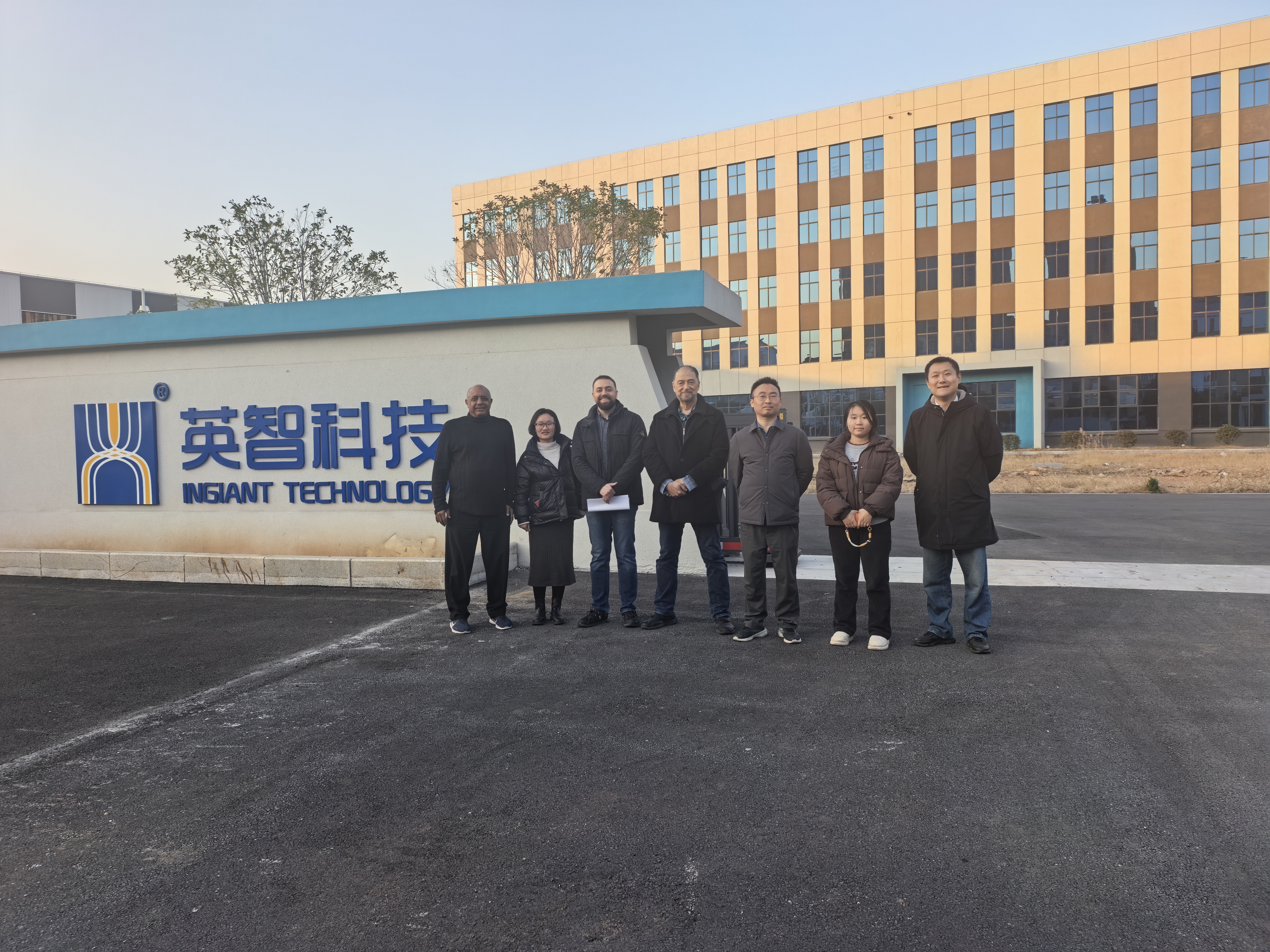
On January 14, 2026, a delegation of Saudi Arabian clients visited Jiujiang In-giant Technology Co., Ltd. Accompanied by Chairman You Manyuan and Foreign Trade Manager Xu Qian, the clients conducted an in-depth inspection of the production plant located in Jiujiang Chengxi Port Area. They also held in-depth technical discussions and demand matching on core products and projects such as rotary connectors, anti-drone turntables, and vehicle-mounted camera turntables, laying a solid foundation for future cooperation between the two parties.
Technical popularization of science: Core Components and Functional Advantages of Vehicle-Mounted Camera Turntables
As one of the key products discussed in this exchange, the vehicle-mounted camera turntable is a crucial piece of equipment for achieving precise positioning and stable monitoring in vehicle vision systems. Its performance directly determines the reliability of scenarios such as vehicle monitoring and environmental perception. The core of this product consists of five key systems, with each module working collaboratively to meet the high-precision control requirements under harsh operating conditions.
- - Motor: Provides power output for the turntable. It needs to dynamically adjust its power according to the torque load during the turntable’s acceleration and deceleration cycles. It also has the ability to withstand peak loads for short periods of time. It is the “power heart” that enables the turntable to operate flexibly.
- - Resolver: As a high-precision position feedback element, it can capture the rotation angle information of the turntable in real time, ensuring that the turntable can maintain the accuracy and repeatability of angle positioning in complex environments. It is the core sensing component for achieving “precise control”.
- - Braking System: It adopts a fail-safe design with spring application and electric release, which can stably maintain the turntable position in emergency stops or slope/tilt scenarios, avoid positioning deviation caused by unexpected situations, and ensure the safety of equipment operation.
- - Communication Interface (CANopen/RS485): Supports two mainstream industrial communication protocols, CANopen and RS485, which can be seamlessly connected to the vehicle control systems of different customers to realize efficient data interaction between the turntable and the host computer and meet the system integration needs in multiple scenarios.
- - Control System: As the “brain” of the turntable, it has three core control capabilities: position control (precisely locking the monitoring angle), speed control (adjusting the speed of the turntable rotation), and torque control (adapting to power output under different loads). It can also be configured with custom acceleration/deceleration curves according to customer needs and can be expanded with customized functional modules to maximize the matching of specific customer application scenarios.
Benchmarking against customer-supplied standards: In-giant’s parameters achieve accuracy exceeding expectations.
During this exchange, both parties focused on the technical documents previously provided by the Saudi customer (including detailed specifications for motors, resolvers, braking systems, system integration, etc.) and conducted technical parameter benchmarking verification based on the RT520-12Nm sample test report (product number: 540002) issued by Jiujiang In-giant Technology. The results showed that In-giant Technology’s product performance fully met the standards, and the accuracy of some parameters far exceeded the customer’s expectations.
Motor performance: Precise and controllable power output, significantly improved adaptability to operating conditions.
In response to the customer-supplied documentation’s specific requirements for core indicators such as motor power, torque, voltage, and speed, In-giant achieved precise parameter implementation and performance upgrades by optimizing the motor winding design and control logic.
- Torque and Power Performance: Customer requirements specify a continuous torque ≥4Nm and a peak torque ≥12Nm for the motor. Test data shows that sample number 2540002 exhibits a stable linear increase in torque output under different currents.
With peak torque redundancy of 3.12 Nm at 1A, 6.55 Nm at 2A, 9.81 Nm at 3A, 13.23 Nm at 4A (exceeding peak requirements), 16.37 Nm at 5A, and 19.73 Nm at 6A, the output characteristics of 144 W rated power and 488 W peak power can flexibly adapt to different torque load scenarios and avoid insufficient power under high load.
- Voltage and Speed Control: Customer-supplied requirements include an operating voltage of 24VDC (overvoltage tolerance ≤28VDC) and a speed range of 0-500RPM (control adjustment accuracy ≤10RPM). Sample test results show that the operating voltage range has been extended to 18-38VDC, with a tolerance range much wider than the customer-supplied standard, capable of handling voltage fluctuations in the vehicle system; the speed range reaches 0-600RPM, with an adjustment accuracy of only 1RPM (far superior to customer-supplied requirements), ensuring stable turntable speed in low-speed monitoring scenarios and meeting high-precision positioning requirements.
- Electrical Stability and Operating Cycle: Customer-supplied insulation resistance meets basic safety standards, with phase-to-phase resistance of 2.3±20%, potential coefficient of 0.33±20%, and operating cycle of S3 or S6 (40%-60% conduction time). The sample insulation impedance is >400MΩ (far exceeding conventional insulation requirements, significantly reducing leakage risk); phase-to-phase resistance is 2.22Ω (within the 2.3±20% error range, resulting in more stable current conduction); potential coefficient is 0.359V/rpm (within the 0.33±20% standard range, providing better linearity of power output); and it fully meets the S3/S6 operating cycle requirements, adapting to long-term intermittent operation conditions.
Resolver performance: Breakthrough in position feedback accuracy and superior environmental adaptability
As the core feedback component for high-precision positioning of the turntable, the resolution, repeatability, and other indicators of the rotary transformer are strictly limited by the customer-supplied documents, and sample number 2540002 performs particularly well in this module:
- Significantly exceeding the accuracy requirements: Customer-supplied requirements for angular resolution ≤ ±0.5 arcminutes and repeatability ≤ ±0.1°. Test data shows that the sample resolution reaches 0.005 arcminutes (only 1% of the customer-supplied standard) and repeatability reaches 0.002° (only 2% of the customer-supplied standard), which can control the angular positioning error during the turntable rotation process to a very small range, fully meeting the precise tracking requirements of vehicle-mounted cameras for target monitoring.
- Signal and Structure Compatibility: The customer requires an output signal of 2V RMS, with a preferred brushless, radiation-resistant, and shock-resistant structure. The sample output signal has an effective value of 2.01V (within the 2±20% standard range, the signal amplitude is stable and without fluctuation); at the same time, it adopts a brushless resolver design, which reduces mechanical wear and can maintain stable performance in complex environments such as electromagnetic interference and vibration, thus meeting electromagnetic compatibility and environmental adaptability requirements.
Braking system: Sufficient safety redundancy, higher control flexibility
The customer-supplied documentation specifies clear requirements for the safety and control methods of the braking system. Sample number 2540002 enhances system reliability through fail-safe design and wide voltage compatibility.
- Braking Torque and Safety Design: The customer-supplied requirement is a holding torque ≥10Nm, employing a fail-safe design with spring application and electric release. The sample holding torque reaches 10.5Nm (5% exceeding the customer-supplied standard), which can stably lock the turntable position in emergency stops or slope/tilt scenarios, avoiding positioning deviation due to brake failure; the braking method fully complies with the “spring braking, electric release” requirement, automatically triggering braking upon power failure, meeting the core requirement of “fail-safe holding”.
- Voltage Adaptation and Control Integration: Customer-supplied requirements include a 24VDC operating voltage (compatible with 24-28VDC) and braking status feedback (microswitch or Hall sensor). The sample’s operating voltage range is extended to 18-40VDC, compatible with voltage output fluctuations in different vehicle systems; the control method supports both 24V control and manual control modes, and precise braking status (on/off) feedback is achieved through a microswitch, which can be synchronized to the control system in real time for easy fault diagnosis, meeting the customer’s requirements for control integration.
Control system: Comprehensive functionality and enhanced customization adaptability
The customer-supplied documentation requires the control system to have multiple interfaces, multiple control modes, and diagnostic functions. Sample number 2540002 further enhances the completeness of functions and customization flexibility based on this requirement.
- Communication and Control Modes: Customer requirements include support for CANopen or RS-485 interfaces, with position, speed, and torque control modes. The sample is compatible with both CANopen and RS485 interfaces (exceeding the “choose one” requirement for customer supply, allowing flexible adaptation to different customer communication protocols); the control modes fully cover the three elements of position, speed, and torque, enabling precise locking of the turntable rotation position, smooth speed adjustment, and dynamic torque adaptation, meeting the control needs of different application scenarios.
- Curve Configuration and Diagnostic Functions: Supports configurable acceleration/deceleration curves as required by customer specifications, with built-in temperature, current, and voltage monitoring and diagnostic functions. The sample not only allows for flexible configuration of acceleration/deceleration curves but also upgrades to a “comprehensive diagnostic” function. In addition to basic temperature, current, and voltage monitoring, it can capture abnormal equipment operation signals and provide early warnings of potential faults. It also supports customized addition of functional modules according to customer requirements, maximizing the matching of personalized needs and exceeding the basic requirements of customer-supplied systems for integration.
Post time: Jan-15-2026