
I. Basic Knowledge: Core Concepts and Unit Conversions
(1) Core Definitions
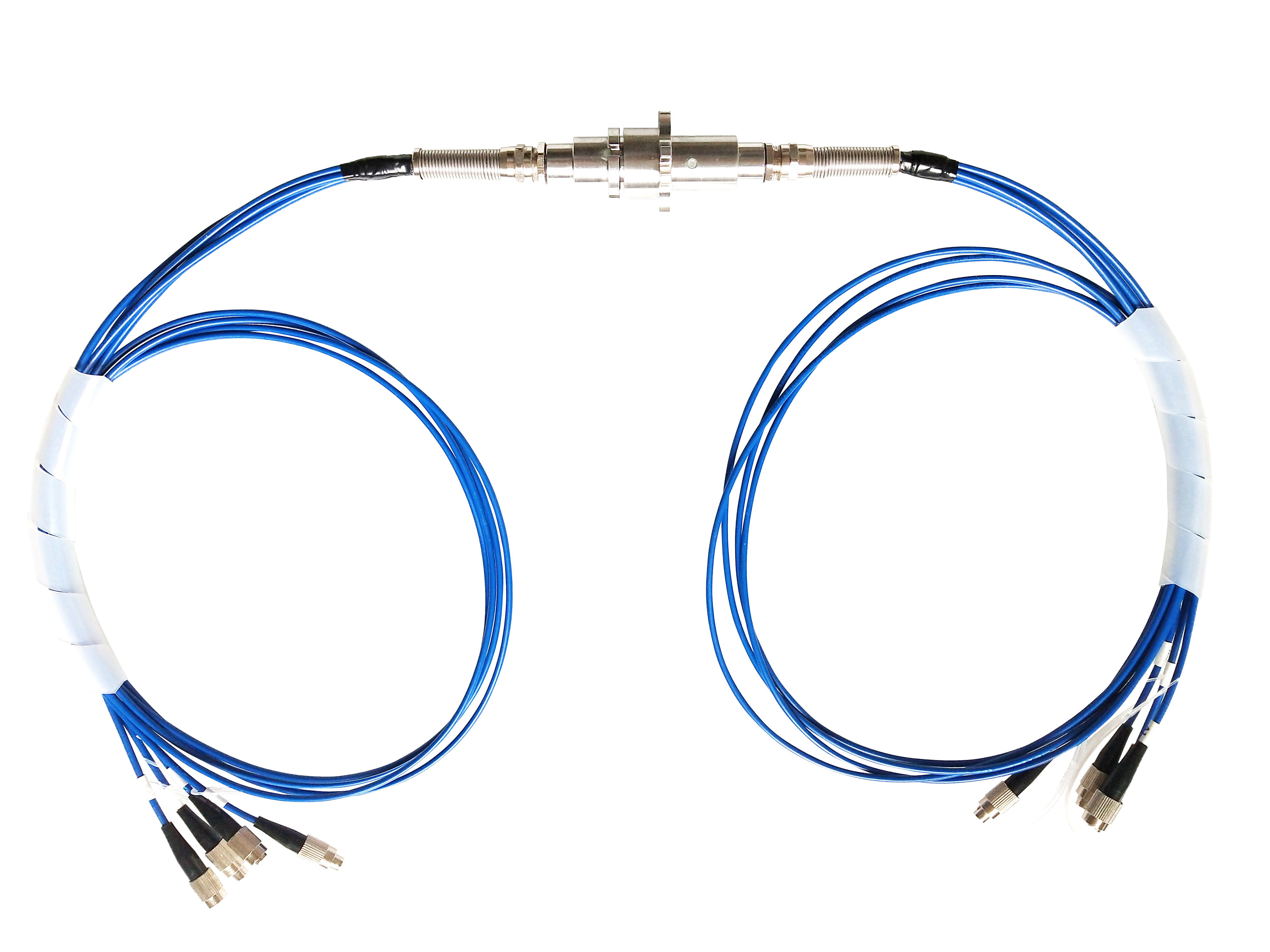
Fiber optic slip ring (also known as fiber optic rotary connector or optical combiner ring) is a precision device that uses optical fibers as the data transmission medium to enable uninterrupted optical signal transmission between rotating and stationary components. It can be used independently or combined with an electrical slip ring to form a “hybrid opto-electrical slip ring,” suitable for scenarios requiring 360° rotation and stable signal transmission (e.g., winches, tethered drones, opto-electrical pods, pan-tilt units, etc.).
(2) Key Prior Knowledge-Length Unit Conversion
To comprehend the core principles of fiber dimensions, one must master the microscopic length relationships (fiber cores typically measure in micrometers):
- 1 meter (m) =10 decimeters (dm) =100 centimeters (cm) =1000 millimeters (mm)
- 1 millimeter (mm) =1000 micrometers (μm) = 10^6 nanometers (nm) (i.e., 1 μm = 10^-6 m, 1 nm = 10^-9 m)
- Key correlations: The single-mode fiber has a spot diameter of 9μm, while multi-mode fibers exhibit various spot diameters such as 50μm and 62.5μm. The cladding layer diameter is 125μm (equivalent to 0.125mm, approximately 1/5 the diameter of a human hair), requiring unit conversion to comprehend its precision.
(3) Definition at Room Temperature
Performance parameters of optical fiber slip rings (e.g., insertion loss) are typically labeled with ‘room temperature’ specifications, as defined by industry standards.
- Normal range: 10~40℃ (laboratory standard environment, civilian products)
- Wide range: -20°C to +80°C (Industrial grade)
- Military-grade standard: -40℃3 to +65°C (product testing and factory calibration benchmark)
- Note: For temperatures exceeding 10-40°C, consult the ‘Full Temperature Performance’ section, which serves as a key criterion to differentiate civilian, industrial, and military-grade products.
II. Fiber Optic and Slip Ring Core Structure
(1) Composition and Classification of Optical Fibers
1. Basic Structure of Optical Fiber
- Core layer: Glass fiber core (material: silicon dioxide, for optical signal transmission)
- Coating: Different dielectric layers (achieving total internal reflection, diameter 125μm, glass material)
- Protective layer: outer plastic (PVC/PU, resistant to physical damage, compatibility-dependent with slip ring)
2. Fiber Classification (By Transmission Mode)
| Type | Spot diameter | Coating diameter | Annotation method | Characteristic | Applicable scene |
| Single-mode optical fiber | 9μm | 125μm | 9/125 | Low loss, long distance (without mode dispersion) | Long-distance transmission (wind power, long-distance monitoring) |
| Multi-mode optic fiber | 50μm/62.5μm | 125μm | 50/125、62.5/125 | High bandwidth, short distance (with mode dispersion) | Short-range high-bandwidth (drone pods, machine tools) |
| Special multimode | Custom size (e.g., 100μm) | 125μm/250μm | Mark as needed | Adapt to special interfaces | Niche industrial equipment, medical instruments (OCT) |
3. Differences in protective layer materials
| Material quality | Temperature range | Physical characteristics | Applicable environment | Matters need attention |
| PVC sheath | -20℃~80℃ | Moderate hardness, low cost | Room temperature scenario (laboratory equipment) | Low temperatures (<-20°C) are prone to cracking, leading to fiber breakage. |
| PU (silicone) sheath | -40℃~120℃ | Soft, elastic, and resistant to extreme temperatures | Industrial outdoor, low-temperature scenarios (Northern wind power) | Costs higher than PVC, currently the mainstream choice |
| Armored fiber (PU + steel armor) | -40℃~120℃ | Resistance to bending and tripping | Adverse operating conditions (mining, underwater equipment) | The easy to become “antenna” under high frequency electromagnetic field and the introduction of electromagnetic interference |
(2) Slip Ring Structure and Key Components
1. Overall Structure
- Single-loop slip ring: housing frame + rotating shaft + 2 collimators + 1 optical path, simple structure and low cost.
- Multi-channel slip ring: Requires a prism and precision mechanical structure, with a rotor-stator speed ratio of 2:1 (2 rotor rotations = 1 stator rotation) to counteract the doubling effect of light angle. The light spot size is only 9/50/62.5μm, requiring tooling and fixture adjustments, resulting in higher costs compared to single-channel systems.
2. Core component differ3ences (by product grade)
| Assembly | Civil products | Induatrial grade | MIL products / Premium items |
| Prism | Less-than < | < | < |
| Glue | Regular glue | High temperature resistant adhesive | MIL special adhesive |
| Protective process | No aging / baking | Conventional aging (48 hours) | Full high-low temperature cycling (10 cycles) + 72-hour aging |
| Inspection phase | Simplified testing | Partial high and low temperature screening | 100% full performance test |
II. Product Classification: Performance, Cost, and Application Scenarios
According to the temperature range, performance parameters, and production processes, optical fiber slip rings are classified into three categories: civilian, industrial-grade, and military/precision, with significant differences:
| Hierarchical dimension | Civil products (general grade) | Technical grade | Military products / Premium items |
| Operating temperature range | 10~40°C (Only room temperature) | -20~+80℃ (Wide temperature range) | -40~+65℃ (Full temperature range; military-grade products can operate from-55℃ to 125℃) |
| Insertion loss (room temperature) | Manufacturing deviation ≤1.2dB, guaranteed ≤2dB | Manufacturing noise ≤1dB, guaranteed ≤3.5dB | Factory output ≤0.7dB, full temperature range ≤2dB (military-grade products: ≤3.5dB) |
| Insertion loss (room temperature) | Manufacturing deviation ≤1.2dB, guaranteed ≤2dB | Manufacturing noise ≤1dB, guaranteed ≤3.5dB | Factory output ≤0.7dB, full temperature range ≤2dB (military-grade products: ≤3.5dB) |
| All temperature loss stability | Significant fluctuations under high and low temperatures | Fluctuation ≤1.5dB | Fluctuation ≤0.5dB (no performance degradation in mil-grade products) |
| Channel consistency (multiplex) | No requirements (single-channel difference can exceed 2dB) | No mandatory requirement (difference ≤1.5 dB) | Single-channel difference ≤1dB (loss uniform across channels) |
| Production engineering | No aging/testing, production based on empirical data | Partial high/low temperature screening + conventional aging | Full high-low temperature test + 100% aging + full testing |
| Price (single channel reference) | Less-than < | < | < |
| Applicable scene | Constant temperature and humidity (for laboratory and civil monitoring) | Industrial outdoor (wind power, general machine tools) | Mil industry (radar, ships), extreme environments (high altitude, underwater), high reliability (medical) |
| Life span | 2-3 years at room temperature | 5 to 8 years at ambient temperature | 10-15 years at ambient temperature (Mil-grade MTBF ≥100,000 hours) |
hierarchical core logic
- The essence of affordable civilian products: omitting aging and extreme temperature tests, with low material costs, only ensuring ‘useability at room temperature,’ while performance plummets under extreme temperatures.
- The inherent cost of mil3-grade products stems from three key factors: (1) upfront defect exposure through full-cycle testing (including thermal cycling and aging), (2) material selection with precision engineering, and (3) extreme environmental reliability assurance—all of which entail substantial per-test costs.
- Industrial-grade positioning: Balancing cost and reliability to meet the ‘wide-temperature non-extreme’ requirement, with reduced failure rates achieved through partial screening.
IV. Key Technical Parameters and Their Impacts
(1) Core Performance Indicators
| Parameter name | Definition | Influence | Industry standard range (by level) | Customer concerns |
| Insertion loss (dB) | Power attenuation after optical signal transmission | The higher the loss, the shorter the transmission distance; multiple slip rings in series result in cumulative losses. | Civil products ≤2dB (room temperature); Industrial-grade products ≤3.5dB (all temperatures); Military-grade products ≤2dB (all temperatures) | Transmission distance (system redundancy required) |
| Working speed (rpm) | Maximum rotational speed of stationary work | Excessive upper limit causes optical path offset and a sharp increase in loss | Standard: 0-1500 rpm; Custom high-speed: 0-3000rpm | Device rotation speed (e.g., 1500rpm for machine tools) |
| Insulation resistance (MΩ) | Insulation capability of Circuit and shell | Low insulation with high Leakage risk, compromising safety | All grades ≥500 MΩ (1000 VDC, room temperature) | High-voltage environment Safety (e.g. ship power supply) |
| Voltage endurance (V/Hz) | High voltage withstanding capability | Circuit breakdown due to insufficient voltage withstand | All levels ≥1000V/50Hz (between two circuits) | High pressure environment applicability |
| Life (turn) | Rotations per stable revolution at rated condition | Depends on the bearing and coaxiality | Civilian: 120 million rpm; Industrial: 250 million rpm; Military: 500-1000 million rpm | Equipment maintenance cycle (e.g., 20 years maintenance-free for wind power) |
(II) Key Influencing Factors
- Coaxiality: The primary metric for modular slip rings, where deviations may cause 1.5-2 year accelerated wear (a common issue in marine equipment). Military-grade components are manufactured with 3D-CMM-controlled precision (≤0.01mm).
- Temperature: Thermal expansion and contraction may cause misalignment of the optical path. PVC sheathing is prone to cracking at low temperatures (<-40°C), so PU-clad fiber should be selected.
- Electromagnetic interference: Armored optical fibers are susceptible to interference in high-frequency electromagnetic fields. In strong electromagnetic environments, unarmored fibers with grounding are required (effectively addressing only low-frequency interference).
V. Special Technical Solutions
(1) Wavelength Division Multiplexing (WDM) Technology-Low-cost Multiplex Transmission
1. Principle
The optical signals of different wavelengths (e.g. 1270/1290/1310/1330/1350nm) are transmitted through a single optical fiber. A “wavelength splitter” is installed at the transmitter end, and a “wavelength combiner” is installed at the receiver end. These components are used in pairs to achieve “single optical fiber = multiple channels”.
2. Strengths and Weaknesses
- Advantages: Significantly lower costs (1/10th of the cost of multiplexers versus multi-channel slip rings) and reduced fiber usage.
- Drawbacks: The hardware design is complex (requiring multiple wavelength modules), field wiring is prone to errors (signal loss due to wavelength reversal), and maintenance costs are high in the long run.
3. Applicable scenarios: Cost-sensitive civilian batch equipment (e.g., civilian surveillance systems) with third-party maintenance responsibilities.
(2) Limiting the Speed of the Ring-A Short Life and Low Cost Solution
1. Principle
The optical fiber is wound into a spring-like elastic coil, with a fixed number of turns (e.g., 40 turns) and a counter. The coil is limited in both forward and reverse rotation (e.g., 10 turns forward / 10 turns reverse). Exceeding the limit causes the spring to break, thereby severing the optical fiber (similar to the principles of “screw winding” or “spring-loaded bicycle”).
2. Characteristics
- Service life: 2-3 years (due to spring fatigue fracture), requiring frequent replacement in later stages.
- Cost: Initial investment is low, but the total long-term cost exceeds that of standard slip rings (requiring 5 replacements over 15 years, with cumulative costs per replacement).
- Applicable scenarios: Temporary inspection equipment and middlemen who make a profit by selling spare parts (e.g., winches requiring annual replacement of components).
(3) Laser Slip Ring-A Wireless High Speed Solution
1. Principle
No physical fiber optic connection is required. The system employs wireless transmission via a rotating laser emitter and stationary receiver, operating at a low frequency of 1MHz with a rotational speed of 1500-2000 rpm.
2. Strengths and Weaknesses
- Advantages: Non-contact operation, wear-free (bearing lifespan ≥1 billion revolutions), and electromagnetic interference resistance. It has been patented and applied in wind power systems.
- Disadvantages: Low speed (does not support high-speed data) and is only suitable for “high-speed, low-rate” scenarios.
- Application scenarios: Spindle detection for machine tools, and electric vehicle motor detection (replacing RF solutions to resolve RF interference issues).
VI. Customer Needs Matching and Sales Strategies
(1) Demand Matching Logic
- The environment is determined by temperature range (10-40℃ for consumer products, -20-80℃ for industrial products, below-40℃ for military or fine products).
- Redefined requirements: Number of channels (single/multi), fiber type (single-mode/multi-mode), transmission distance (loss tolerance), and reliability (durability/stability).
- Final cost determination: Low design fee for clients with provided drawings; high design fee for clients without provided drawings; customization requires inclusion of “design + processing + service” costs, excluding shelf-ready products.
(2) Common Customer Issues and Solutions
| Customer issue | Source | Rx |
| Ship equipment shows a sharp 33% increase in wear and tear within approximately 2 years | Coaxiality difference, process not controlled | Recommended for premium-grade products (three-coordinate coordinate measuring for coaxiality), with pre-factory high/low-temperature aging treatment |
| Water ingress in slip ring of underwater equipment | Packaging design defects, inadequate sealing | Select IP68 protection structure and add a pressure compensation module |
| Electromagnetic Interference of Armored Optical Fiber | Armoring under high frequency electromagnetic field | Unarmored fiber + low-frequency grounding; laser slip ring for high-frequency scenarios |
| Burnout of slip ring in high power optical signal transmission | Energy concentration in the diffuser | Customized bell-mouth fiber for energy dispersion requires collaborative development with fiber manufacturers |
(3) Key Points of Sales
- Consultative sales: Avoid pushing high-priced products. Match products to scenarios (e.g., civilian lab items to prevent overdesign and waste).
- Cost breakdown: The price difference stems from three factors-manufacturing process (aging tests), material costs (military-grade prisms are 3 times more expensive), and screening expenses (100% inspection for military-grade products).
- Demonstration of capabilities: Featuring the ISO9001 quality system, 3D coordinate measuring equipment, and fully automated aging production line, we invite clients to tour our facility.
- Post-sale transparency: Consumer products are exempt from mandatory warranties, while industrial-grade and military-grade items come with 1-3 year warranties. The policy clearly states that ‘initial low price equals higher maintenance costs later’ (e.g., limit ring speed requires replacement after 2 years).
VII. Application Fields
| Domain | Specific equipment | Recommended product grade | Key Requirements |
| Civil / Industrial | Surveillance cameras, wind power equipment, packaging machine tools | Civil / Industrial | Room temperature / wide temperature range, low loss, cost controllable |
| Mil Industry / Ships | Radar antenna, ship fire control system, UAV pod | Mil products / Premium items | Temperature stability, vibration resistance, and channel consistency |
| Medical treatment | OCT system, CT equipment | Premium (Low Loss) | High precision, low interference (without affecting imaging) |
| Special scenarios | Underwater sealing equipment, mining machinery | Industrial-grade / Premium (Armored) | Waterproof, anti-bending, and resistant to harsh working conditions |
Note: The application has no fixed domain and depends on the requirements of the device designer. For scenarios without copper plating and requiring high electromagnetic interference resistance, fiber slip rings are recommended.
Post time: Dec-19-2025